Today the baby still seemed very heavy. Holding the baby while you are writing or taking a test is difficult because you have to make sure to hold the baby properly which can hurt your arm while you are trying to write. As we continue this project, I am learning how hard it is to carry for a baby and all of the responsibilities that come with a baby.
Each day seems to continue to be getting harder. I've noticed that one of the hardest parts of carrying around the baby is when you are at your locker trying to get your books out. Going from class to class can even tire your arms out because you have a heavy baby and a heavy book. At first, having the baby was not too bad but the baby is really heavy so things just seem to be getting harder.
Today was the third day of carrying around the baby. Each day seems to be getting harder and harder. Holding the baby in one arm makes things especially hard because you only have one free hand. With books in one hand and a baby in another, your arms become very tired. Each day I am realizing how hard caring for a child is and all of the responsibilities that come with a child.
Carrying Riley around all day has become very tiring. It is especially hard when I am at my locker trying to get books out and having to hold him at the same time. He is an extremely big responsibility and it's becoming harder to care for him. After a while my arm also begins to hurt because he is so heavy. I do enjoy having a partner who can also take care of him and hold him for part of the day. Carrying the baby around all day has made me realized that a baby is a lot of work.
We have decided to name our baby Riley. Riley is a beautiful little boy and I am very excited now that I can hold him and take care of him. He is a very big responsibility though and caring for him is very tiring. Carrying Riley around all day gets exhausting because he is so heavy. Being with Riley is fun but having to constantly care for him can become a lot of work. Now that I am caring for Riley all day long, I understand how big of a responsibility a baby really is. You have to constantly be holding him, he must be held a proper way, and you must be very gentle. Riley may be a lot work but having him is a joy.
Life card: Mom, you think you are gaining too much weight so you stop eating. This is understandable for Mom because she is not used to the weight gain and she may feel self- conscious. Mom should not stop eating though because by her not eating, the baby is also not eating. If Mom does not eat while pregnant, the baby will not get the proper nutrients needed to grow. The spinal cord and brain of the growing fetus is easily damaged and requires a daily supply of 600 to 800 mcg folic acid or defects such as spina bifida will ensue. Lack of calcium rich foods, such as salmon, spinach and dairy, stop the baby from forming healthy bones and teeth. Pregnant women who do not eat will not provide any milk, much less nutrient dense milk for the baby. Mom also can have problems if she doesn't eat. Anemia and cavities are just some of the health obstacles a pregnant woman will face if she stops eating while pregnant. Anemia robs mom of energy, oxygen and concentration as the fetus takes the mom's iron storage to survive. Similarly, the growing bones of the baby will leech calcium from the mother's if she is not eating.
Week 17: Your baby, now about in its 15th week of development, measures about 4.4 to 4.8 inches from crown to rump and has doubled in weight in the last two weeks to about 3.5 ounces. Fat begins to form, helping your baby's heat production and metabolism. The lungs are beginning to exhale amniotic fluid, and the circulatory and urinary systems are working. Hair on head, eyebrows and eyelashes is filling in.
Week 18: Your baby measures 5 to 5.6 inches from crown to rump and weighs about 5.25 ounces. The rapid growth spurt is tapering off, but reflexes are kicking in. It can yawn, stretch and make facial expressions, even frown. Taste buds are beginning to develop and can distinguish sweet from bitter tastes. The baby will suck if its lips are stroked and it can swallow, and even get the hiccups. The retinas have become sensitive to light, so if a bright light is shined on your abdomen, baby will probably move to shield its eyes.
Week 19: Your baby measures about 5.2 to 6 inches from crown to rump and weighs about 7 ounces. Skin is developing and transparent, appearing red because blood vessels are visible through it. Creamy white protective coating, called vernix, begins to develop.
Week 20: The fetus measures about 5.6 to 6.4 inches from crown to rump and weighs about 9 ounces. Your baby can hear sounds by now -- your voice, heart and your stomach growling, as well as sounds outside your body. It will cover its ears with its hands if a loud sound is made near you, and it may even become startled and "jump." The baby is moving often, too -- twisting, turning, wiggling, punching and kicking.
Week 21: Your baby measures about 7.2 inches from crown to rump and weighs about 10.5 ounces. The fetus is steadily gaining fat to keep warm. Growth rate is slowing down but organ systems, like digestion, are continuing to mature. A waxy film, called the vernix caseosa, is being produced by your baby's oil glands and covers the skin to keep it supple in the amniotic fluid. Buds for permanent teeth are beginning to form.
Week 22: Your baby measures about 7.6 inches and weighs about 12.3 ounces. The muscles are getting stronger every week now, and the eyelids and eyebrows are developed. Your baby's acrobatics are pretty constant, and since he responds to sound, rhythm and melody, you can try singing and talking to him. After he's born, the same sounds will soothe him.
Week 23: Your baby is about 8 inches from crown to rump and weighs almost 1 pound. The body is becoming proportioned more like a newborn, but skin is still wrinkled because your baby still has more weight to gain. Lanugo hair on the body sometimes turns darker.
Week 24: Your baby, now about in its 22nd week of development, is 8.4 inches from crown to rump and weighs about 1.2 pounds. It is starting to produce white blood cells, mostly for combating disease and infection, and may respond to your touch or sounds. If you haven't felt hiccups yet, you might feel some jerking motion now.
Life Card: You’re moving from the country to the inner city.This can affect Mom because the country is very quiet and relaxing where the city is much busier.Mom may become more stressed because of the noise and amount of commotion going on around her.This could affect the baby because Mom is not relaxed and calm.Mom also may not be resting enough because the noise could be keeping her awake.
Timeline:
Week 8: Your embryo, now about in its sixth week of development, is about the size of a grape -- 0.56 to 0.8 inches from crown to rump. Eyelid folds and ears are forming and even the tip of the nose is visible. The arms have grown longer and bend at the elbows. Places where fingers and toes eventually will grow are becoming notched.
Week 9:The embryo measures about 0.9 inches to 1.2 inches from crown to rump, or the size of a strawberry. The arms and legs are longer, and the fingers might be a little swollen where the touch pads are forming. The head is more erect and neck is more developed. Your baby now moves its body and limbs, and this movement can be visible during an ultrasound, but you won't be able to feel it yet.
Week 10:Your baby is now officially called a "fetus." It looks a little like a medium shrimp, measuring 1.25 to 1.68 inches from crown to rump, and weighing a little less than two-tenths of an ounce. You might be reassured to know that most physical malformations, when they occur, have occurred by the end of this week, so the most critical part of your baby's development is safely behind you. But other developmental processes, such as those affecting behavior and intelligence, will continue throughout pregnancy. Eyes are covered by skin that will eventually split to form eyelids.
Week 11: Your fetus, about the size of a large lime, measures about 1.75 to 2.4 inches from crown to rump and weighs about three-tenths of an ounce. About now the rapid "swooshing" noises of the heartbeat can be heard through a Doppler sound-wave stethoscope. Fingernails and external genitalia are showing distinguishing characteristics, and the baby is swallowing and kicking, although you still won't feel it.
Week 12:The fetus now measures about 2.5 inches from crown to rump and weighs between three-tenths of an ounce and half an ounce. It is fully formed, from tooth buds to toenails, and your baby's job now is to continue getting larger and stronger for the rest of your pregnancy. With the most critical development behind the fetus, the chance of miscarriage drops considerably after this week.
Week 13:Your fully formed fetus, now in about its 11th week of development, measures 2.6 to 3.1 inches from crown to rump and weighs between half an ounce and seven-tenths of an ounce -- about the size of a peach. The head is still disproportionately bigger than the body, but the rest of the body is starting to catch up. In fact, your baby is growing rapidly these days. The face is starting to look more human, with eyes moving closer together. Toes and fingers are clearly separate, and ankles and wrists have formed. External genitalia are becoming visible. Intestines are shifting into their proper place, too.
Week 14:Your baby measures about 3.2 to 4.1 inches from crown to rump now and weighs almost an ounce. The ears are shifting from the neck to the sides of the head, and the neck is getting longer and chin more prominent. Facial features and unique fingerprints are all there. Your baby is beginning to respond to outside stimuli. If your abdomen is poked, the fetus will try to wriggle away.
Week 15:Your 13-week-old fetus now measures about 4.1 to 4.5 inches from crown to rump and weighs about 1.75 ounces. Its body is covered by an ultrafine hair, called lanugo, which is usually shed by birth. Eyebrows and hair on the top of the head are beginning to grow. He may even be sucking his thumb by now. Bones are getting harder.
Week 16:Your baby now measures about 4.3 to 4.6 inches from crown to rump and weighs about 2.8 ounces. Fingernails are well-formed and the fine hair, lanugo, may be growing on the head. Arms and legs are moving. The nervous system is functioning and muscles are responding to stimulation from your baby's brain. You may be able to hear the baby's heartbeat in the doctor's office.
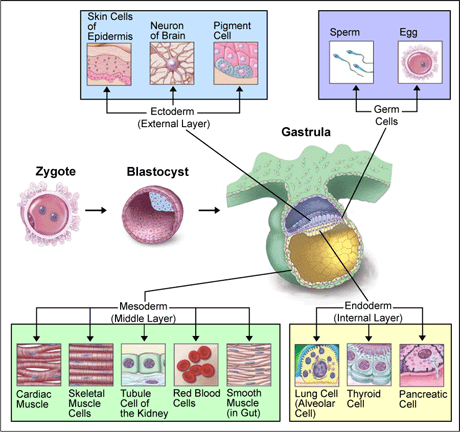
Cell differentiation is a process in which a generic cell develops into a specific type of cell in response to specific triggers from the body or the cell itself. This is the process which allows a single celled zygote to develop into a multicellular adult organism which can contain hundreds of different types of cells. In addition to being critical to embryonic development, cell differentiation also plays a role in the function of many organisms, especially complex mammals, throughout their lives.
The steps involved in differentiation:
1. The Morula Stage
2. The Blastula Stage
3. The Gastrula Stage
4. The Neurula Stage
The germ layers and the systems formed from them:
Endoderm- The endoderm forms the epithelial lining of the whole of the digestive tube except part of the mouth and pharynx and the terminal part of the rectum.
Mesoderm- The mesoderm forms the skeletal muscle, the skeleton, the dermis of skin, connective tissue, the urogenital system, the heart, blood, and the spleen.
Ectoderm- The ectoderm forms the central nervous system, the lens of the eye, cranial and sensory, the ganglia and nerves, pigment cells, head connective tissues, the epidermis, hair, and mammary glands.
I am very excited that our baby will be a boy! I am also very excited about which name to give the baby and now that we are aware that the baby is a boy, my partner and I will be able to dress the child in adorable clothing. I am still worried about the health of the child and if he will have any problems or diseases.
Options for parents who have miscarried their baby or thought they were pregnant and are not:
If you had a miscarriage, you are probably going through and extreme grief and pain but there are options if you wish to have another child. One option is adoption. Many parents adopt a child if they are not able to get pregnant. You also have the choice of hiring a surrogate to carry your child. Another option would be artificial insemination which is when sperm are inserted directly into a woman's cervix, fallopian tubes, or uterus. This makes the trip shorter for the sperm and bypasses any possible obstructions. Ideally, it makes pregnancy possible where it wasn't before.
Development of your baby from 4 - 8 weeks gestation.
The fifth week after conception, tiny arm and leg buds have formed. Hands with webs between the fingers have formed at the end of the arm buds. Fingerprints are detectable. The face has a distinctly reptilian aspect. The sixth week after conception, the embryo is about 1/2" long. The face has two eyes on each side of its head; the front of the face has connected slits where the mouth and nose eventually will be. During the seventh week after conception, the embryo has almost lost its tail. The embryo measures ¼” in length. Lens pits and optic cupseye. The brain divides into 5 sections, leg buds form, and hands form as flat paddles on the arms. In the eighth week after conception, the embryo will be about 8-11 mm long. The baby's hind brain is clearly visible. This week the baby's gonads will become either testes or ovaries and spontaneous movement begins. Also, the elbows appear and the process of ossification begins. form the start of the developing
How Mom's body is changing.
A mom’s body is experiencing many changes. Some things a mom will experience are nausea, acne, stretch marks, weight gain, and in increase in the production of hormones. It is very common for pregnant women to feel nauseous during their first and second trimester. The nausea may vary, but most often it occurs either in the morning or in the late evening. Also, a mom might see an increase in acne on her face and on various parts of her body. Acne is a normal way for her body to adapt to the chemical changes and should not remain or continue after her pregnancy is over. Women may start to see lines forming on their abdomen, thighs, hips, buttocks, or arms as they gain weight. Moms may feel overwhelmed by these changes, they do not have to. Women will also experience a significant amount of weight gain and women become very hormonal. There will be an increase in estrogen and progesterone which stimulate the growth of your breasts and milk glands.
What are the odds of having twins or triplets?
The chances of having twins these days are about one in 32 births. This rate has gone up 65 percent since 1980, and it's more than double the rate among women who conceive without medical assistance — one in 89.The rise in triplets and quadruplets is even more dramatic. Between 1980 and 1998, the rate of triplets and higher-order multiple births shot up by more than 400 percent, but it's crept back down over the past few years as fertility treatments have become more refined. In 2003, one in 535 births resulted in triplets, quadruplets, or more.Meanwhile, the likelihood of having identical twins is about one in 250. This rate has stayed constant all over the world.
How do you choose a doctor/midwife...or can your baby be born at home?
Women have the choice of choosing a midwife or doctor for their pregnancy. Women who either have medical problems or have had a previous c-section and know that they are going to have another one, choose to see an obstetrician because only they can perform c-sections. A midwives’ office is much more personal, friendly, and quicker than a doctor’s office. The wait isn’t as long, and the midwife is willing to listen and answer all your questions no matter how long it takes. While in labor, either at home or the hospital, a midwife will generally not leave the mothers side until labor is over, remaining with the mother to give constant support. Midwives are usually more personable and more willing to listen. Midwives generally support and believe in a more natural, comfortable birth for the mother and baby, as well as using less traditional birthing aids such as birthing balls and water births. Also, if a mother-to-be wants to have a home birth, a midwife is who she would choose to assist her. Doctors can offer a lot of benefits as well. Often a doctor can come with a lot of recommendations from friends. Many times you will actually see all the doctors at different appointments so you’ll get to know each one. You will also be able to get several different opinions regarding any problems you might be having in your pregnancy in one place, rather than having to go elsewhere for a second opinion. Also, if your doctor is ill, or has to deliver a baby, you probably won’t have to reschedule your appointment because there should be another doctor that you could see in the practice that day. Obstetricians can also support and believe in a more natural method of childbirth, but they can also be quick to recommend pain medication during labor. They might also be quick to recommend a c-section if labor is not progressing as fast as they want.
Safety Tips for a Healthy Pregnancy.
Start changing your food habits to include a healthy variety of foods.
Exercise! Starting now will help you stay in shape during pregnancy, can lower your risk of miscarriage, and has been proven to help reduce labor complications and length.
Educate yourself! Check out a book on pregnancy.
Stop smoking. There are many programs to help you.
Take a prenatal vitamin. They can be prescribed by your practitioner or you can buy them over the counter. Ensure it contains 0.4 mg of folic acid.
Avoid chemicals that could possibly harm your baby. You can find these at work, in your home, and just about anywhere, be environmentally sensitive.
Stop changing cat litter.
Do not drink alcohol because it can cause birth defects.
Rest when you can.
Drink six - eight ounce glasses of water a day.
Remember to add 300 - 500 calories a day while pregnant.